 Furnishi
Your customer list is the asset. Furnishi is built to protect it.
The partner firm installing your kitchen also installs for your competitors. Every time you send them a name, a number and an address on WhatsApp, you hand over a piece of your database. Furnishi makes that structurally impossible.
Who sees which field.
A simplified view of the live matrix. "part" means the partner sees the pincode and locality needed to reach the site, but not the door number or the customer name.
| Role | Order ID | Customer name | Mobile number | Address | Pincode | Location code | Product & code | Face area | Start / end date | Status | Quote value | Snag cost |
|---|---|---|---|---|---|---|---|---|---|---|---|---|
| Factory Manager (FM) | ||||||||||||
| Customer Coordinator (CC) | — | — | ||||||||||
| Factory Coordinator (FC) | — | — | ||||||||||
| Source Coordinator (SC) | — | — | — | — | — | — | ||||||
| Work Partner (WP) | — | — | part | — | — | |||||||
| Survey Partner (SP) | — | — | part | — | — | — | — |
The same screen, two accounts.
No filter was applied and no setting was changed between these two screenshots. Only the account changed.
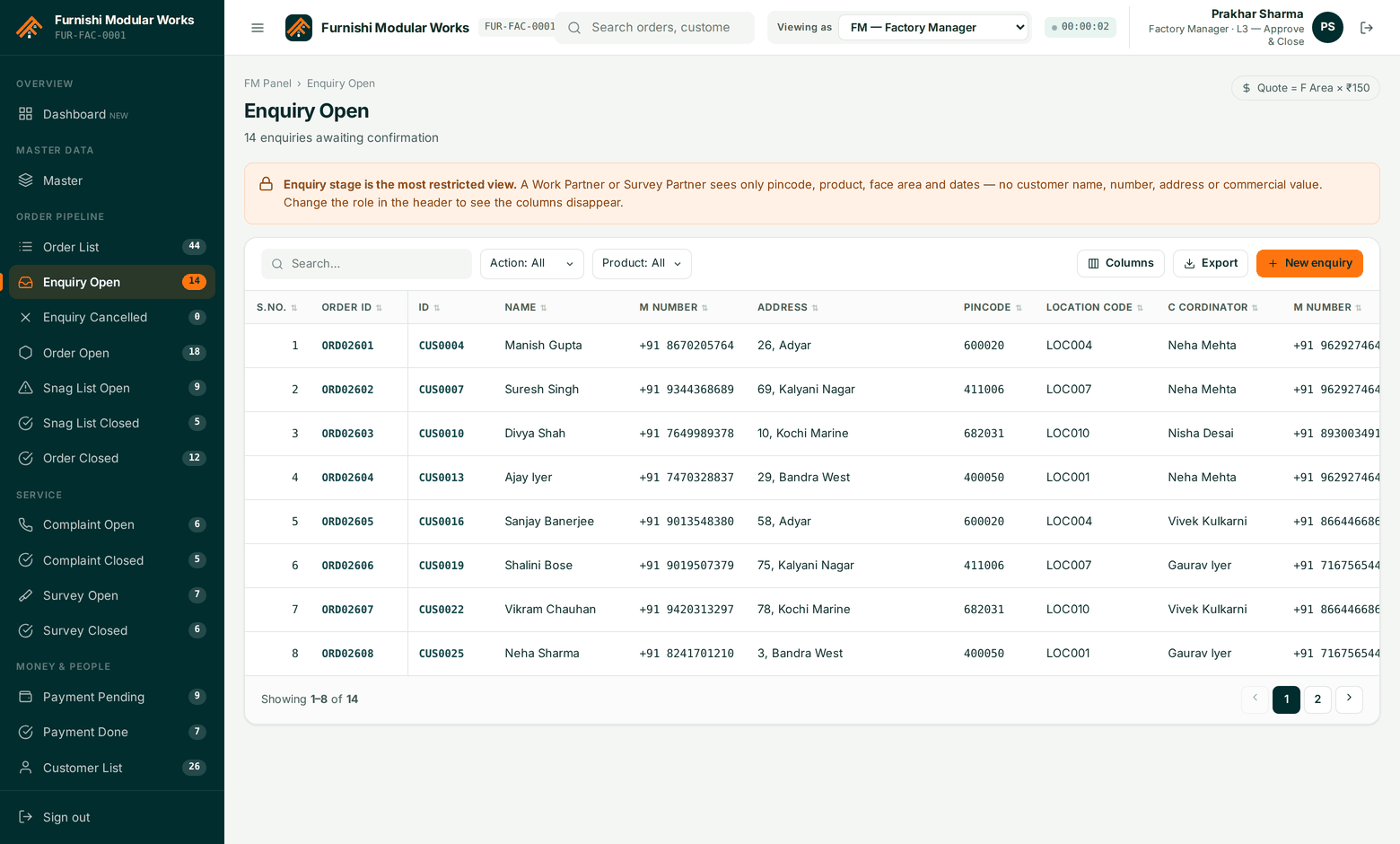
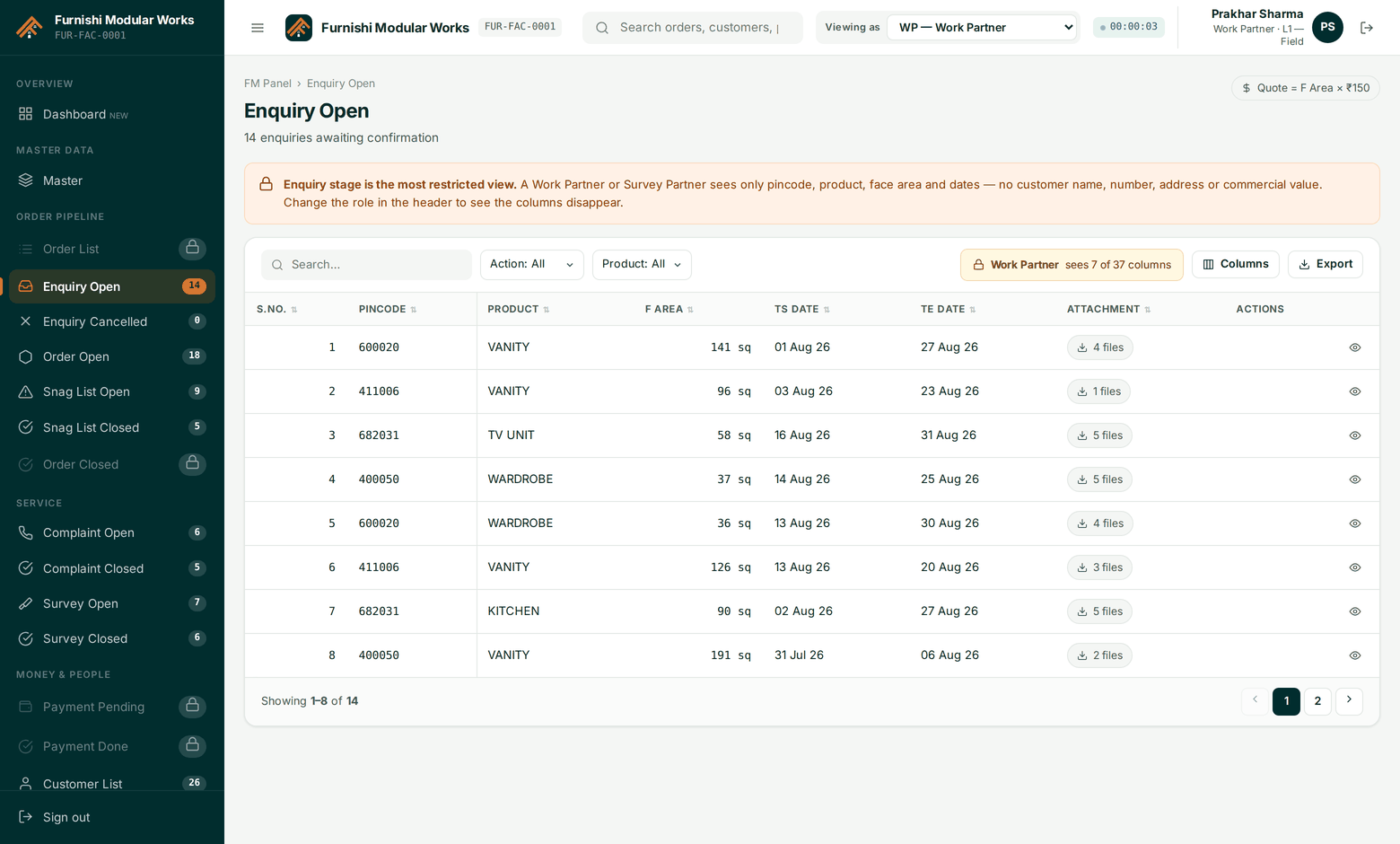
Hiding a column is not security.
Plenty of systems will grey out a field in the interface while the data still travels to the browser, sits in the network response and lands in the CSV export. Furnishi enforces the restriction three layers down.
- Database — partner-facing screens read from views that do not contain the identity columns at all.
- Row level — RLS policies bind every query to one tenant; a partner query cannot cross factories.
- API — the response is built from the role’s allowed field list, so the payload is short.
- Export — CSV is generated from the same list. There is no wider file to download.
- Audit — every read of a restricted field by a privileged user is recorded.
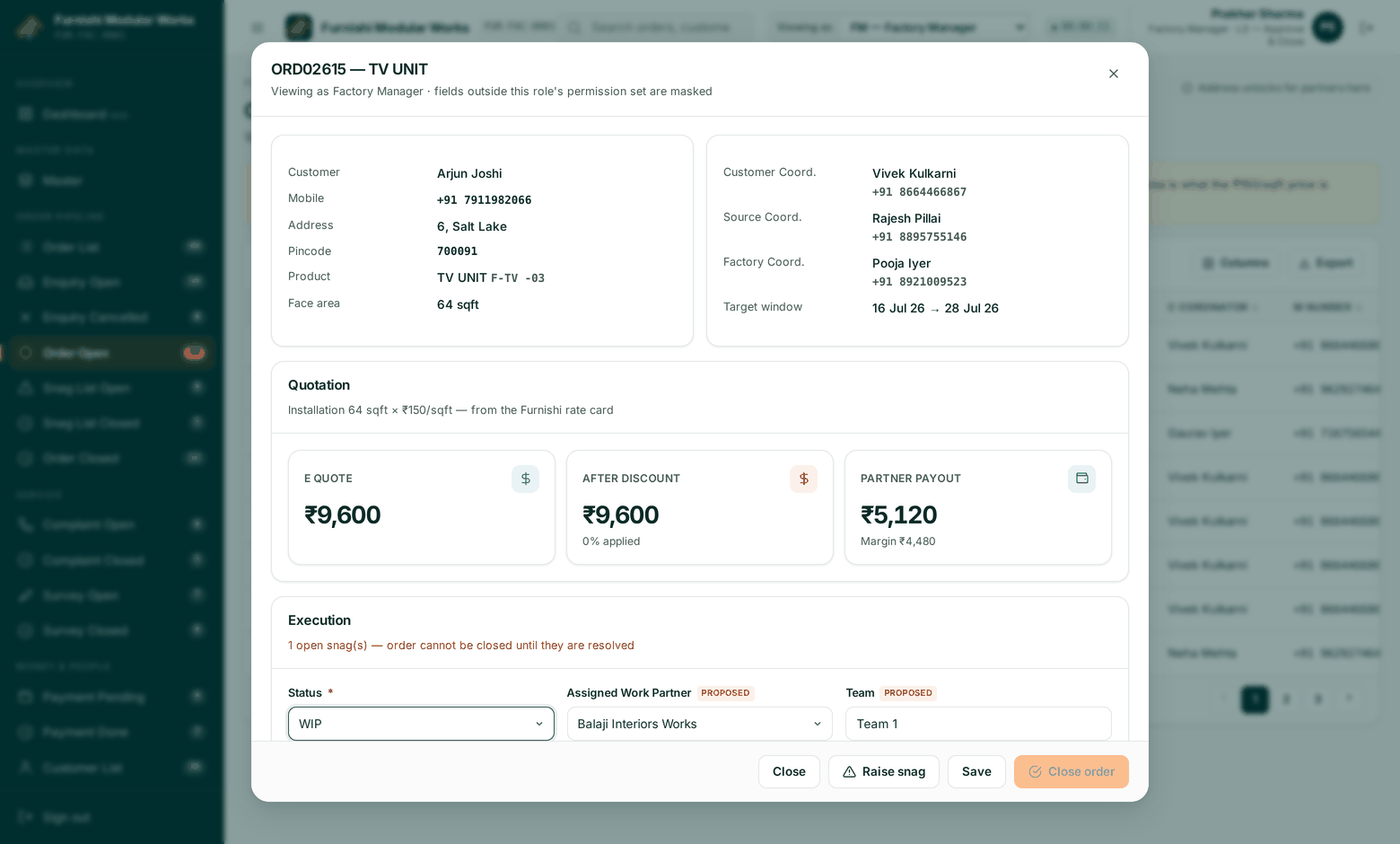
The partner is a supplier, not a co-owner of your customers.
Factories lose repeat business and AMC revenue when a partner firm builds its own relationship with the homeowner. Column-level permissions are the cheapest insurance you can buy against that — and the customer app means the homeowner's relationship stays with your brand, not with whoever turned up with a drill.
Bring your own permission questions to the demo.
Tell us the field you are worried about. We will show you exactly who can see it and where that is enforced.